Following on from last week’s post about My simple process on how not to get interruptedwhen presenting to senior executives, here are five tips to prepare for you next Leadership Team or Board presentation.
1. Think of developing relationship with the senior executives, not as a presentation to them.
2. You will be judged. Acknowledge that and step up to meet that challenge.
A number of my mid-level, executive clients are frustrated when delivering important presentations to their Leadership Team or Board.
They’re frustrated because soon after they start speaking, a member of the Leadership team or Board often interrupts them.
This interruption interferes with their speaking flow, and then a free flowing discussion between the leaders in the room occurs, leaving the presenter stranded and often resulting in deferring a decision on the matter at hand to a later time.
Innumerable hours of time are lost, due to these interruptions.
and it can take months before a final decision is made.
This 6:17 minute scene of Robert Deniro and Al Pacino, from the movie Heatis cinematic gold. (I’m sure some of you know of it).
Watching it – will make you a better communicator – by osmosis. It’s riveting viewing.
It is so good, I feel reluctant to offer any analysis of it.
The main effect of the scene on me was how Deniro and Pacino don’t rush their lines. They ‘own’ time. They take extra seconds as needed, before responding to the other.
Leaving aside what you think Uber, below is my analysis of the the company’s Dara Khoshrowshahi’s presentation of himself and messages, in a 2019 interview with luminary, uber (excuse the pun) interviewer David Rubenstein.
Overall, Khosrowshahi uses an Open, Middle, Close speaking delivery. He is articulate in conveying his thoughts. Like many top-level CEO communicators he is ‘light’ about himself (note the self-deprecating humour near the start) while taking his role seriously.
Rubenstein’s default style could be described as ‘playful’ – with the ability to shift to a more serious style as needed.
Imagine you’re a trainee doctor, about to get grilled in an oral examination, or as it is called in the medical field, a viva.
Below are tips given to trainee doctors on how to prepare for their vivas, that you can adapt. My comments on the respective tips are in brackets. The tips are from a stellar article, Twelve tips for performing well in vivas,by Rob Selzer, Steven Ellen, Laila Rotstein and Robert Roseby.
#1 Behave professionally. The posture when seated should be erect and comfortable. Slouching, leaning back, leaning across the table, do not reflect professionalism in our view.
Please read this vignette by Gary Hamel, American management expert, as quoted in the book, ‘The Captain’s Myth’ by Richard Gillis.
First, assume you have no positional authority. No job title. And second, assume you have no sanctions,’ says Hamel. ‘If someone doesn’t agree there’s nothing you can do. Then ask yourself what could you get done with those two assumptions. If you can do something amazing, you are a leader.
‘In looking back on an unpleasant or disagreeable experience, the thought inevitably occurs to us: if only we had said or done x instead of y, if only we could do it over.
Many a general has lost his head in the heat of battle and then, looking back, has thought of the one tactic, the one maneuver, that would have changed it all.’
This quotation is from p 21 of the landmark book, The 33 Strategies of War, by Robert Greene.
Recently a client of mine – a CIO of a major federal, government department – told me the power of my suggestion to develop a regular habit of using his phone to video record himself delivering a short message and then immediately watching the playback, as a means of self-coaching – can’t be over-estimated.
Part of the power of the recording habit, he said, was the ability to get an objective view of himself.
‘… when we feel powerful, even our voices spread out and take up more space than they do when we feel powerless. Stanford University psychologists Lucia Guillory and Deborah Gruenfeld refer to this as “a way of claiming social space.” We don’t rush our words. We’re not afraid to pause.
We feel deserving of the time we’re using.
We even make more direct eye contact while we’re speaking.Guillory and Gruenfeld suggest slow speech demonstrates a kind of openness: “When people speak slowly they run the risk of being interrupted by others. In speaking slowly one indicates that he or she has no fear of interruption. People who speak slowly have a high chance of being heard clearly and understood. They also take up the time of those with whom they’re communicating.” *
Here are my views on the above vignette:
# Overall, I agree with the piece with some caveats (please see below). It aligns with my view that – if you are perceived as rushing, that is junior behaviour. If you are perceived as owning time, that is senior behaviour.
# The point of ‘no fear of interruption’ is an important one. That is, a speaker’s strong, internal belief, that he/she should not be interrupted; that his/her view should be heard – will effect the listener and cause the listener to be silent during the speaker’s delivery.
# I believe Gruenfeld and Guillory ‘speaking slowly’ recommendation is Not, advising to speak with a monotone cadence.
Of course, in robust group discussions people will interrupt you. My advice to clients is that they prepare and do mock practice of their communication delivery, for being interrupted. Here is one way to respond upon being interrupted by a peer.
With a firm, even vocal tone, say for example:
‘X, I haven’t finished’/’Let me finish please’(and then continue to speak your message).
This response should be used judiciously with interrupters who are senior to you. However, my field research on using these responses with peer and junior interrupters, indicates this. When the interrupter receives this response, on just one occasion, they’ll be less likely to interrupt you in the future.
# It is critical that while speaking slowly, that the speaker’s voice has energy. A dull voice even if slow in delivery will encourage interruption.
# Clarity and structure of a message is also crucial if a speaker doesn’t want to be interrupted
(*I have misplaced the name of the book that the quote was contained in. If you know the book, please let me know. Thanks)
Own the Conversation
A good way to practice speaking slowing is to use my signature ‘Measuring Cup’ speaking technique.
Here is a 2:12 video CLIP of me demonstrating the ‘Measuring Cup’ speaking technique.
I suggest you:
Over the next seven days, on purpose in safe interactions, speak while utilising the Measuring Cup technique
++++
p.s. The producer of the podcast 10 Lessons it took me 50 years to learn, recently told me this 43:14 minute Episode, All agreements are with yourself, in which I was interviewed by Duff Watkins, is the most downloaded Episode to date. I encourage you to listen to it, if you haven’t already. Thanks
(Image by Dickson Donatus from Pixabay)
Michael Kelly, a body language expert has weighed in for 7 News, as Prince William and Harry were seen conversing together after their grandfather Prince Philip’s funeral service on Saturday AEST.
By Alex Turner-Cohen and Elizabeth Daoud for 7NEWS
PUBLISHED: 18/04/2021
A body language expert has weighed in as Prince William and Harry were seen conversing together after their grandfather Prince Philip’s funeral service on Saturday AEST.
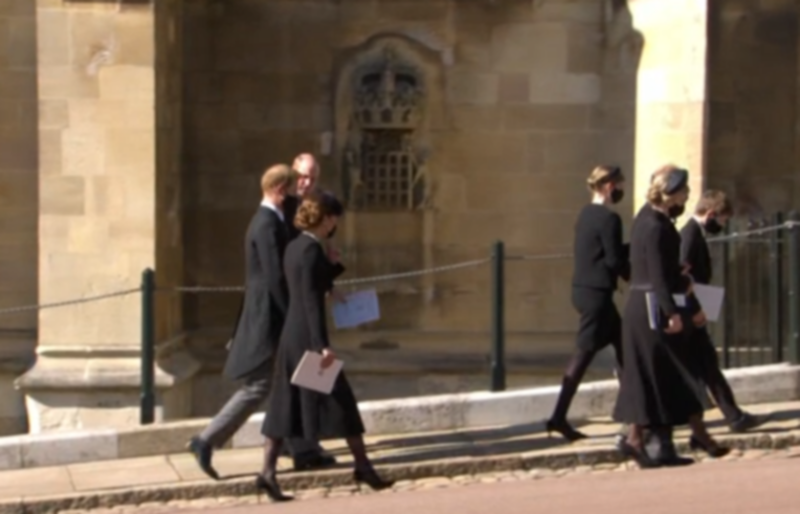
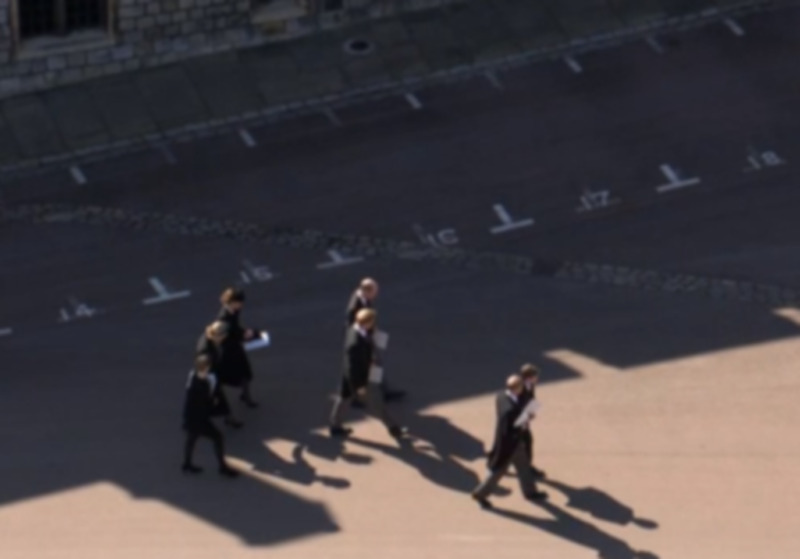
The estranged brothers were spotted walking and chatting together, along with William’s wife Kate, right outside the church.
Harry went to thank the Archbishop of Canterbury outside the church and then went over to speak with Kate, the duchess of Cambridge, where he was joined by his brother William.
Michael Kelly, a body language and speech expert, said all the tension slid away as the brothers’ conversed.
“It seemed like there’s no rancour at all. (The brothers) could have been walking down the country lane,” he told 7NEWS.com.au.
Harry, William and Kate. Credit: ITNThe brothers were pictured chatting. Credit: ITN
That’s despite a fraught history between William, 38, and his younger brother Harry, 36.
There have long been speculations about a rift between the royal relatives, which was all but confirmed during an explosive interview with Oprah last month.
As Meghan and Harry spilled all in the controversial interview, Harry spoke about his difficult relationship with Prince William.
“The relationship is space at the moment and time heals all things, hopefully,” he said at the time.
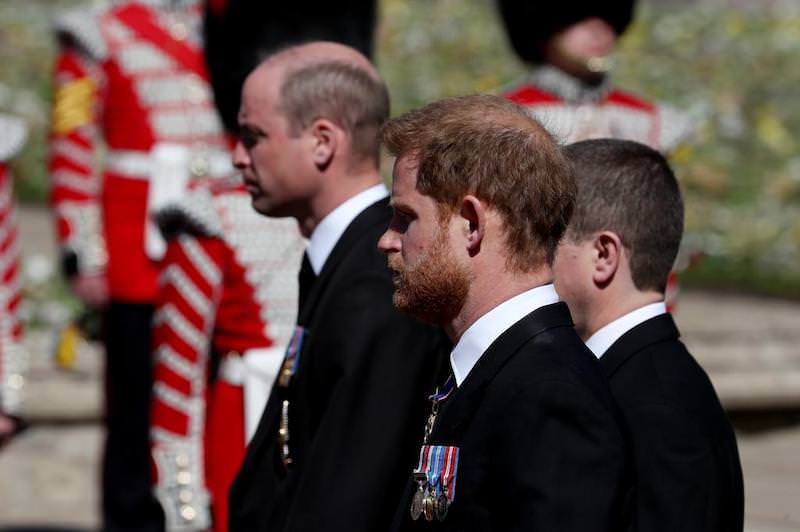
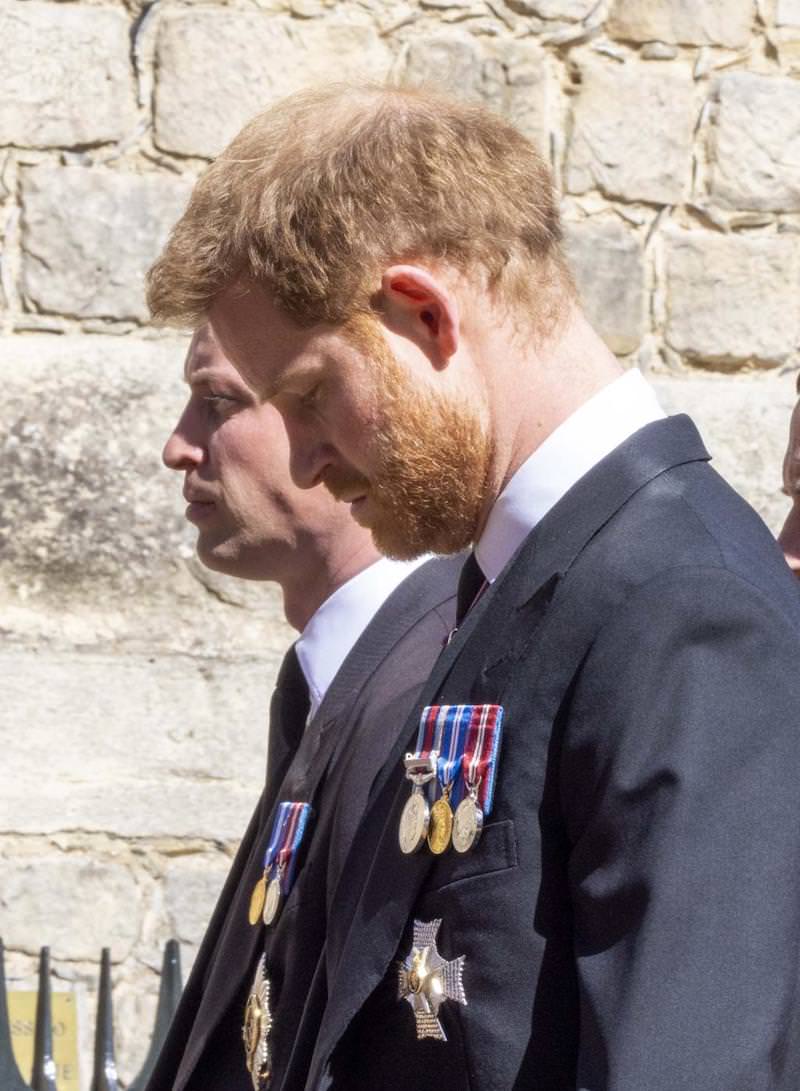
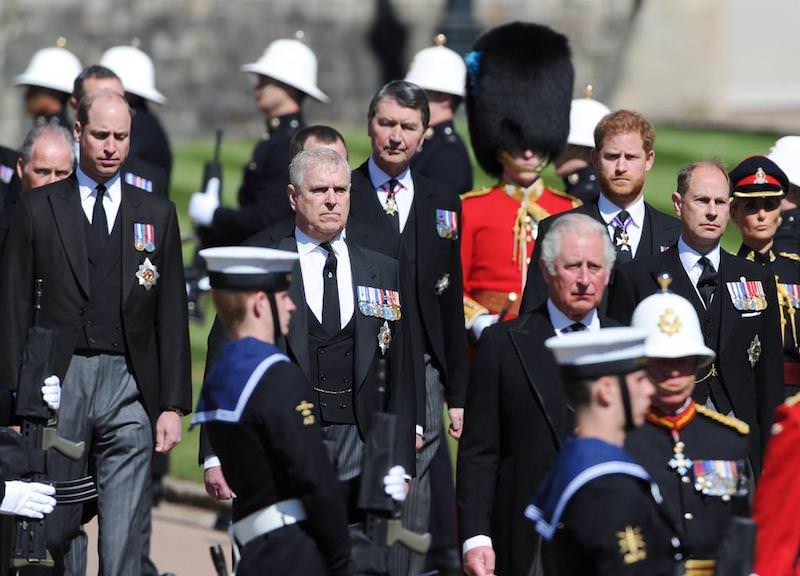
During the funeral service, Princes William and Harry did not line up shoulder to shoulder as they took their places for the procession.
Peter Phillips has stood between Prince William (left) and Prince Harry (right). Credit: APPrince William, Duke of Cambridge and Prince Harry, Duke of Sussex were separated during the funeral service. Credit: WPA Pool/Getty ImagesHarry and William were at first separated at the funeral service. Credit: Samir Hussein/WireImage
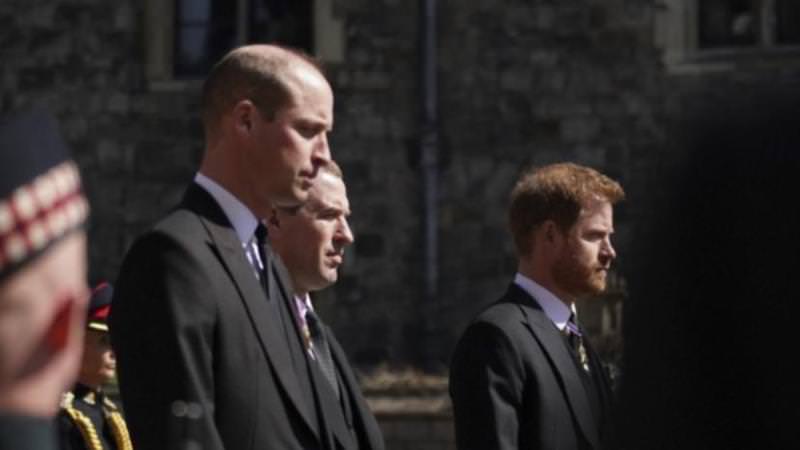
William and Harry’s cousin Peter Phillips stood between the princes as they prepared to escort the coffin to St George’s Chapel at Windsor Castle.
Kelly said although the body language was tense and stressed, this was most likely because of the circumstances of their grandfather’s passing.
He also pointed out that the configuration of the brothers had been pre-arranged by the queen and the separation was not an indication of any ill will between them.
‘No rancour, no animosity’
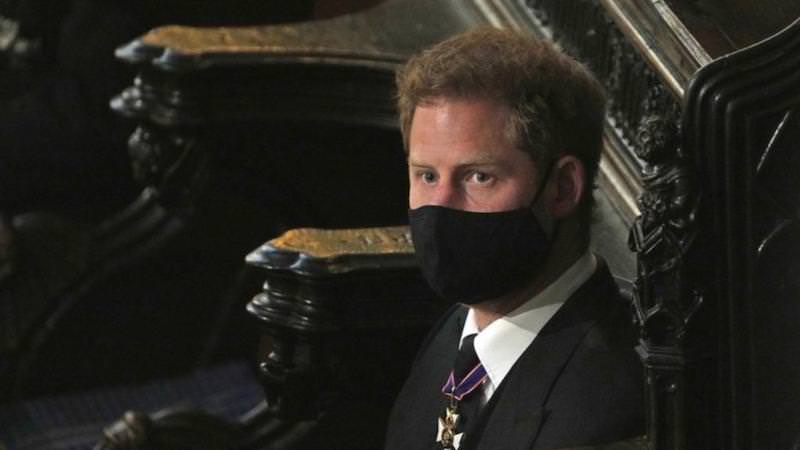
After the funeral, Prince William was mask-less as they walked and talked outside but Prince Harry kept his mask on – which makes it more difficult to read his facial expressions.
But Kelly is certain that reports of the brother’s friction must be exaggerated.
“They could have been walking down the golf course,” the body language expert said.
“There wasn’t any tension.”
Harry wore a mask, making it difficult to pick up on his facial queues. Credit: APThe estranged brothers were spotted walking and chatting together, along with William’s wife Kate, right outside the church. Credit: WPA Pool/Getty ImagesAll together again: Harry, William and their father Charles can all be seen in close proximity during the funeral. Credit: WPA Pool/Getty Images
Kelly said their shoulders were relaxed and everyone appeared at ease on the short walk.
The way they were leaning in together appeared almost “confidential”, like the brothers were sharing a secret.
He said this was “consistent with the occasion of their grandfather’s funeral”, when personal differences should be put aside.
Kelly also said Harry appeared to be getting along well with his sister-in-law, Kate.
“It seemed like he was (like this with) Kate as well – no rancour, no animosity. They seemed in general just sombre”.