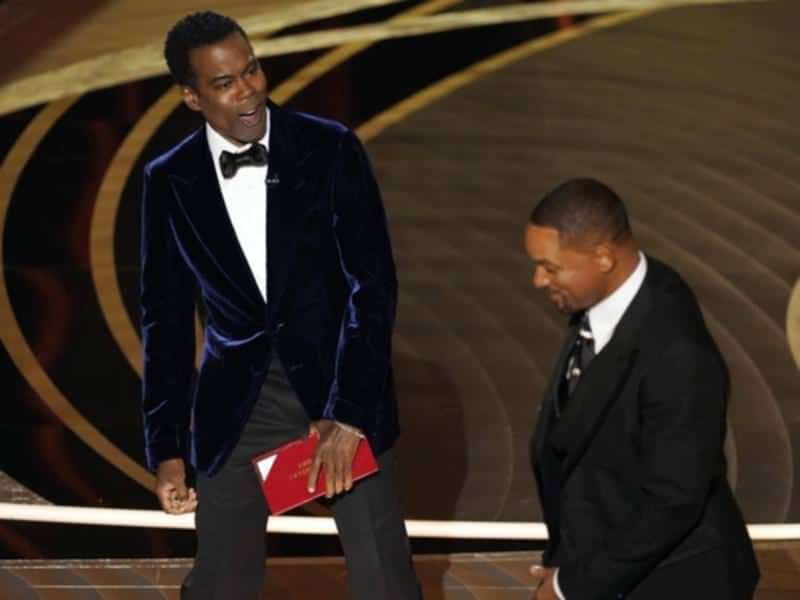
A day after one of the most shocking moments in Academy Awards history, many have weighed in on Will Smith’s controversial slap, whether he was provoked and how the Oscars organisers should deal with it.
Will Smith struck presenter and comedian Chris Rock across the face during the awards ceremony on Monday, after taking offence to a joke about his wife Jada Pinkett Smith.
While Smith has since apologised, intrigue surrounds the incident and the moments leading up to it.
Australian body language and speech expert Michael Kelly, told 7NEWS.com.au he believes Will Smith knew “exactly what he was doing” when he walked on stage and approached Chris Rock.
“When Chris was making the joke, it almost seems like Will was just processing it … it seemed like it slowly dawned on him that it was an offence on him,” Mr Kelly said.
“It seemed as if he laughed and then went, ‘hold on’.”
Mr Kelly suggested Smith’s rage “bubbled up” inside him as he approached the stage.
“When he walked up, you knew what he was going to do, it felt like what else would he do besides hit him … it was a purposeful walk.”
Minutes later, after Smith won the Best Actor, Mr Kelly said his acceptance speech was full of “deep emotion”.
“He was deeply impacted,” Mr Kelly said.
“It was deep emotion and his voice was shaky.
“It was quite the confluence of things, winning the award and having Chris Rock insult him. I think when he apologised (to the Academy, rather than Rock personally) he was just keeping it together.”
Mr Kelly also added he was “surprised” at how well Chris Rock took the slap.
The following might be controversial . . .
I always wondered what was at the core of Boris Johnson keeping his job as Prime Minister of the United Kingdom, after he faced scandal after scandal after scandal.
Many commentators maintained that the Downing street parties, scandal would see Johnson exit as PM. When he survived that wrongdoing there was commentary, that the reason for his survival, was that there was no one in the Conservative party, except Johnson, who could win Britain’s next election against Keir Starmer.
However, in my view, one sentence in this incisive Atlantic magazine article, Boris Johnson – Inside The Controlled Chaos Of Downing Street, bellowed at me, as the key reason for Johnson’s survival.
Namely,
‘Whenever you talk to Johnson, you bump up against an all-encompassing belief that things will be fine’.
Whenever you see video footage of Johnson, he is always exuding the ‘things will be fine’ aura.
It’s as if he takes any negative and responds – through his facial expression, manner, bearing, body movement, vocal tone and words – with the stated or unstated message,
“Yes, yes, yes … I know that didn’t go well, but things will be fine . . . we’ll figure it out . . . there is a work-around here.”
Johnson believes in the ‘things will be fine’ mantra so deeply, that his listeners believe it too.
As I share in my work with clients in delivering their messages. The first ‘selling job’ is on yourself. And Johnson is well-sold on himself.
The ‘things will be fine’ aura is deeply reassuring to the electorate. Deep down, we want a leader of state who is an unflinching beacon of hope.
Johnson is that unflinching beacon of hope.
Own the Conversation
Implementation idea:
In the next seven days, get feedback from a trusted person on how well you project the ‘things will be fine’ aura, on a 1-10 scale (1 lowest level; 10 highest level).
If the feedback proved useful, engage other trusted people to give you feedback.
Over time, investigate what factors – in the presentation of yourself and your messages – contribute to the ‘things will be fine’ aura.
At the present time, you may be facing fresh challenges from your team as we move into the post-pandemic era.
Your team, most likely, has new expectations about how, when and where they are going to work. Together with the challenges of the ‘great resignation’ how will you manage these staff demands to ensure optimal performance within your team?
I am now providing one-on-one and small group coaching sessions in handling difficult conversations in conjunction with John Le Mesurier. John is an executive coach who specialises in preparing managers for demanding interactions with their staff.
John and I are currently offering a complimentary, ten minute introductory session to demonstrate the benefits that can arise from good preparation and skilful technique in handling difficult conversations.
Please contact me to schedule an introductory session. Thanks.
Leaving aside the value of his policies, and with a benchmark of a credible, believable, inspiring leader of state, here is my analysis of Anthony Albanese’s speech to the Lowy Institute on 10 March.
The speech was the best speaking performance delivered to date by the Leader of the Opposition.
Albanese projected a statesmanlike bearing with a measured, un-rushed speaking cadence combined with an energetic vocal tone. He used strong, disciplined gestures to emphasis key points.
It was a fine performance – until his closing statements – which undermined the entire speech. (Watch from the 37:00 minute mark to the end of the speech)
Albanese’s concluding remarks somehow left me flat and uninspired. It was if he was reciting lines from a script he did not believe.
It was the delivery of the old Albanese.
When an audience hears an uninspiring delivery from a potential leader of state, they will conclude – consciously or unconsciously – that the potential leader is uninspiring. And few voters want an uninspiring leader of state.
Still, Albanese has significantly improved the presentation of himself and his messages.
I suspect he is having presentation skills training.
“The ability to learn faster than your competitors may be the only sustainable competitive advantage.”
This quote (that some of you may know) is by legendary business executive and theorist Arie de Geus
I heard the quote mentioned at a great conference I attended – CIO Edge – organised by a client of mine Jim Berry and his team. Jim is a top performer and is the director of Adapt.
Own the Conversation
Implementation idea:
Over the next seven days1. Pose the following question and discuss it with your colleagues, suppliers and associates.
How might we learn faster that our competitors?2. Log the key take-away points of the discussions.
3. Choose the best idea to act on in the next 30 days.
p.s. I am considering becoming a member of AICD (Australian Institute of Company Directors). If you are a member and would be open to brief chat about the worth you’ve derived from membership, or know of a member who might be open to a brief chat about value of membership, please contact me. Thanks.
“I feel cheesy.”. . . “I feel false.” . . . “I don’t want to project something I’m not.” . . . “I don’t want to be inauthentic.”
When I work with clients on changing how they present themselves and their messages, some clients respond with the above statements. I then suggest that feeling uncomfortable is part of changing behaviour.
I tell them to embrace the paradox of being comfortable with the uncomfortable. That if they’re not willing to be uncomfortable, they’re unlikely to adopt the techniques I share with them.
Below are quotations I send to clients who struggle with feeling inauthentic and false.
‘We tend to latch onto authenticity as an excuse for sticking with what’s comfortable. But few jobs allow us to do that.
Leadership development requires us to move beyond our comfort zones – however doing that triggers strong countervailing impulses to protect our identities.
When we are unsure of ourselves or our ability to perform well, we often retreat to familiar behaviours and styles.
By viewing ourselves as works in progress and evolving our professional identities through trial and error, we can develop a personal style that feels right to us.
It takes courage, because learning starts with unnatural and often superficial behaviours that can make us feel calculating instead of genuine and spontaneous. But the only way to avoid being pigeonholed and ultimately become better communicator is to do the things that a rigidly authentic sense of self would keep us from doing.
Being utterly transparent – disclosing every single thought and feeling – is both unrealistic and risky.’
“Be yourself (in an interview for example) is the worst advice because we have many selves. How we interact with boss, versus best friend versus mother differs.
See yourself as a diamond. A diamond has flaws, cuts depending on how it is held it can shine brightly or not so much. So in any interaction choose the part of the diamond that shines the brightest for this interaction.”
Own the Conversation
Action suggestion
For the next seven days:
Start seeing yourself as a ‘work in progress’.
Aim to let go of ‘your rigid sense of self’.
Try a new communication technique and note how you feel during and after the interaction. (Perhaps have a longer pause before you start speaking; Speak up more than usual in a meeting with C level executives: Introduce yourself to someone you’ve seen more than once at your office building but don’t know.