
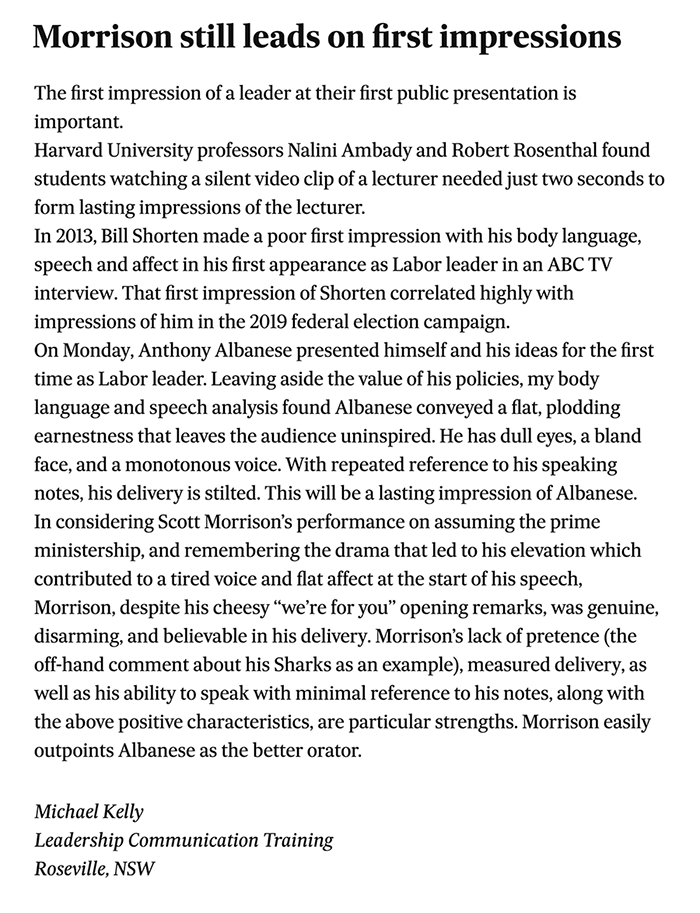
Michael’s letter to the editor featured in the Australian Financial Review, 31 May 2019:
Read the original article here.
Read the original article here.


The first impression of a leader at their first, public presentation – is important.

If ever there was a speech that was the right speech, at the right time, by the right person, in the right manner, for the right reason, and with the right feeling tone –
a speech that had a direct correlation to preventing violence –
Continue reading
As it is election debating season in Australia leading up to a Federal election this month, here is my ANALYSIS of another debate – one of the Donald Trump versus Hillary Clinton’s presidential debates of 2016.
Michael Kelly scores the electoral debate in this 1 May Australian Financial Review article.
Read the original article here.

Political debates between leaders at the National level are about projecting a personality, a bearing, a national and world view that voters find appealing – not about scoring points.
Continue reading
Michael Kelly comments on the first debate of the 2019 election campaign with Scott Morrison and Bill Shorten.
Read the original article here

In 1942, U.S. president, Franklin Delano Roosevelt converted one of his own government department memos- a black out order:
from:
“Such preparations shall be made as will completely obscure all Federal buildings and non-Federal building occupied by the Federal government during an air raid for any period of time from visibility by reason of internal or external illumination.”
Continue reading
